
As Americans gather to celebrate Independence Day, it is worth reflecting on one of the…


The Tiny Snail That Could Become a Big Problem for Montana
It is smaller than a nickel, moves at a snail’s pace and can easily go unnoticed. But the Eastern Heath Snail could become a significant problem for Montana if it continues to spread.
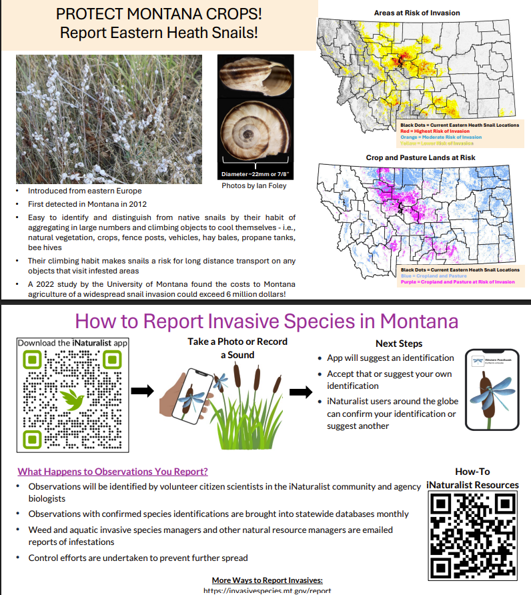
The Eastern Heath Snail (Xerolenta obvia) is a small invasive land snail native to southeastern Europe and Asia Minor. In North America, it has been found in only a handful of areas: southern Ontario, the Detroit area of Michigan and central Montana. The snail has also recently been found in Gallatin County, making awareness and early detection especially important for residents, landowners and agricultural producers in the area.
Montana’s population is particularly noteworthy because researchers have determined that it is genetically different from the populations in Michigan and Ontario. Exactly how the snail arrived in Montana is unknown, although it is possible it was introduced as early as the 1910s on equipment associated with mining operations near Belt. The species was identified as an invasive species in Montana in 2012.Eastern Heath Snails have been documented in dry, open areas of Cascade, Chouteau, Judith Basin and Fergus counties, including Great Falls, near Monarch and Highwood, and along U.S. Highway 87 between Belt and Stanford. The most recent detections, including the recent Gallatin County finding, demonstrate the importance of monitoring for this species beyond its previously known range.
Know what you’re looking for
Eastern Heath Snails are small and easy to mistake for other pale-colored land snails.
Their shells are chalky white with dark brown to black spiral bands. The shell is low and nearly flat, measuring up to about 22 millimeters across — roughly the width of a nickel — and has five to six whorls. The outermost spiral band is usually the darkest, with the bands becoming lighter toward the center. The underside has a wide, obvious opening in the center of the shell, called an umbilicus.
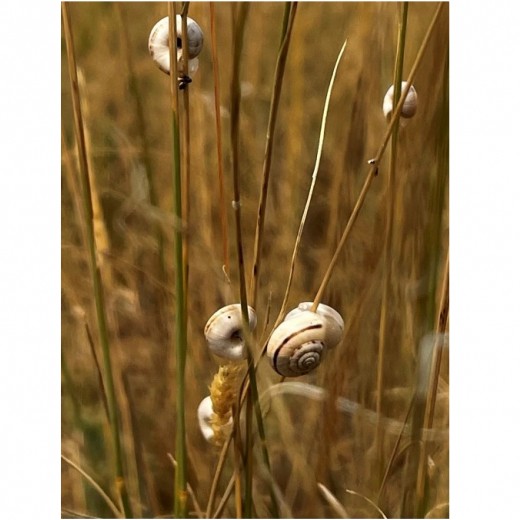
One of the easiest ways to spot an Eastern Heath Snail is not by its shell, but by its behavior.
During hot, dry summer weather, the snails climb grass stems, fence posts, signs, walls, hay bales and other upright objects. They often gather in large numbers, sometimes with dozens of snails clustered on a single stalk.
This behavior, called “massing,” helps the snails escape the heat of the ground. Once they find a suitable location, they seal themselves inside their shells and enter a dormant state called aestivation. Although they may look dead, they are simply waiting for cooler or wetter conditions.
When rain and humidity return, the snails come back down to feed.
Built to survive
Eastern Heath Snails are well suited to Montana’s dry climate. They prefer open, sunny areas such as grasslands, roadsides, pastures, crop fields, rocky hillsides and other dry habitats.
Unlike some invasive species that depend on a particular host plant, Eastern Heath Snails are generalist feeders. They eat a wide variety of living and dead plant material, allowing them to survive in gardens, agricultural fields and natural areas.
They are also remarkably capable of reproducing.
Each snail is a hermaphrodite, meaning it has both male and female reproductive organs. An individual snail can fertilize itself, meaning it only takes one hitchhiking snail to potentially establish a new population.
Snails lay small white eggs in shallow holes a couple of centimeters deep in the soil. Clutches can contain anywhere from a few eggs to several dozen. Research conducted by Montana State University indicates that egg-laying occurs primarily during moisture events in spring and fall.
Eastern Heath Snails generally live two to three years and may take two or more years to reach maturity.
That combination — the ability to reproduce on its own, produce numerous eggs and survive Montana’s hot, dry conditions — makes preventing their spread especially important.
How do they travel?
On their own, Eastern Heath Snails don’t get very far. Their real advantage is hitchhiking.
The snails readily attach themselves to objects and can be transported on hay and straw, farm machinery, vehicles, fencing, landscaping materials, gravel, soil, nursery plants and other equipment.
They have been found on items ranging from lawn mowers and ATVs to propane tanks, construction equipment, barbecues, beehives and hay bales.
This makes human activity one of the most important ways the snail can expand into new areas.
A single snail moved to a new location could potentially start a population.
Why should Montana care?
Eastern Heath Snails feed on a wide range of plants and can become particularly problematic in agricultural areas. They are known to feed on crops including peas, lentils, beans, grapes and forage crops.
Large numbers of snails can contaminate harvested crops and increase cleaning and processing costs. When snails are crushed in combines and other harvesting equipment, their remains can create a sticky residue that dries extremely hard and can interfere with machinery.
A 2022 study by the University of Montana’s Bureau of Business and Economic Research estimated the potential economic impact to Montana agriculture at approximately $1.4 million per year in mitigation and post-harvest processing costs.
There are also concerns about animal and plant health. Eastern Heath Snails can serve as intermediate hosts for parasites affecting livestock, including sheep and goats, and may carry certain plant fungal diseases.
In natural areas, large populations could also compete with native snails and affect vegetation in dry grasslands and other habitats.
What can landowners do?
Early detection and preventing the movement of snails are among the best tools Montana has to slow their spread.
With the recent detection in Gallatin County, residents and landowners should be especially alert when moving equipment, hay, gravel, soil, landscaping materials or other items that could transport snails or their eggs.
If you find an Eastern Heath Snail, remove it and make sure it is dead. Crushing the shell is one way to ensure the snail does not survive. Infested materials should not be transported to another location.
Landowners can also make their properties less attractive to snails by removing trash, debris and dense vegetation that provide shelter. Keeping vegetation mowed to about five inches or less can make it more difficult for snails to climb and mass.
Raking, grading, rolling or resurfacing areas with crushed stone or gravel can also reduce suitable habitat and help crush shells.
For small infestations around gardens or homes, hand-picking snails when they are clustered on vegetation or posts can be effective. Snails can be placed in soapy water or sealed in a bag and disposed of in the trash.
Chemical snail baits may be useful around small areas, but they are not considered a practical solution for large infestations. Anyone considering chemical control should contact a local Extension office or licensed applicator for current recommendations.
Don’t move the problem
Because Eastern Heath Snails are currently known from only a limited number of locations in North America, preventing their spread to new areas is critical.
The recent Gallatin County detection is a reminder that invasive species do not always stay where they are first found. Before moving equipment, hay, gravel, soil or other materials, take a few minutes to inspect for hitchhiking snails.
Look for small, chalky-white snails with dark spiral bands. During hot, dry weather, check grass stems, fence posts, signs, walls, hay bales and other upright objects. Large clusters of small white snails are an especially important warning sign.
If you think you have found an Eastern Heath Snail, do not move it to another location. Photograph it and report the sighting to your local MSU Extension office or the Montana Department of Agriculture at 406-444-9066.
A tiny snail may seem insignificant, but early detection and a little awareness could help prevent a small population from becoming a much larger agricultural and environmental problem for Gallatin County and Montana.
Becky Clements – Gallatin Conservation District