
It is smaller than a nickel, moves at a snail’s pace and can easily go…


Invasive Annual Grasses in Montana
With warmer winter conditions and spring just around the corner, it’s time to start thinking about the invasive annual grasses in Montana. This article is a very broad overview of the impacts these invasive annual grasses have on Montana’s economy and ecosystem….
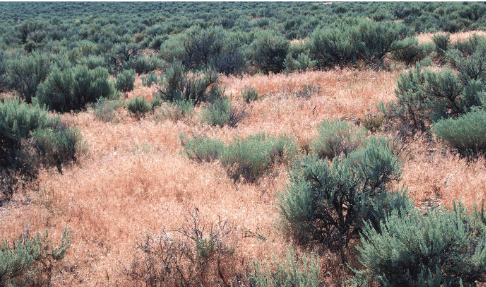
Invasive annual grasses have emerged as one of the most pressing ecological and economic challenges across the rangelands of Montana, profoundly altering landscapes once dominated by native perennial grasses and diverse plant communities. These non-native/invasive species — notably Cheatgrass (Bromus tectorum), Medusahead (Taeniatherum caput-medusae), Ventenata (Ventenata dubia), and Japanese brome (Bromus japonicus)— are increasingly prevalent in semi-arid grasslands and mixed-grass prairies of Montana. Their spread is driven by their aggressive growth cycle, high seed production, and ability to establish in disturbed soils, whether from grazing, construction, or natural fluctuations in climate conditions.
One major impact of these invasive annual grasses is the degradation of native plant communities. Once they become established, they often out-compete native perennial grasses and forbs for moisture and nutrients. Cheatgrass, for example, germinates in the fall and grows early in spring, preempting soil moisture and establishing dense stands that leave limited resources for slower-growing native species. This competitive advantage enables invasive grasses to dominate ground cover across large areas.
Perhaps the most visible consequence of this shift is the altered wildfire regime across Montana’s rangelands. Invasive annual grasses dry out earlier in the season than native vegetation and accumulate continuous fine fuels across the landscape. These fuels significantly increase the probability of ignition and can carry fire rapidly across what once were more fire-resistant native grasslands and shrublands. Although recent research suggests that wildfire isn’t always the primary trigger for invasive grass expansion, the presence of continuous invasive fuel greatly enhances fire frequency and intensity where these grasses dominate.
The impact on agricultural operations may also be substantial. Invasive annual grasses generally provide poor forage quality and quantity for both livestock and wildlife. Ventenata and Medusahead, for instance, are unpalatable to most grazers due to its high silica content and coarse structure, reducing usable forage and leading to economic losses for ranchers.
Biodiversity suffers alongside agricultural productivity. Dense stands of invasive grasses diminish habitat suitability for native wildlife species and reduce plant species richness. The thick litter layers these grasses create can also inhibit the germination of desirable native plants and disrupt soil processes that support a healthy ecosystem.
Efforts to manage and mitigate these impacts are underway. Land managers, researchers, and conservation programs are experimenting with integrated tools — from herbicide applications and prescribed grazing to revegetation with competitive perennial species — aimed at reducing invasive annual grass populations and restoring resilience to native plant communities. Montana State University and federal agencies are actively engaged in studies to develop effective, cost-efficient strategies for controlling invasive annual grasses while promoting long-term ecological health.
In summary, invasive annual grasses in Montana are not just weeds on the landscape — they represent a system-wide disruption to ecological function, wildfire behavior, agricultural viability, and biodiversity. Addressing their spread requires sustained, science-informed management and cooperation among landowners, researchers, and public land managers to preserve the ecological and economic integrity of Montana’s rangeland ecosystems.
Cheatgrass (Bromus tectorum)
- Most widespread and problematic
- Turns landscapes reddish-purple in early summer
- Dries early → major wildfire risk
- Outcompetes native grasses and reduces forage
Japanese brome (Bromus japonicus) – common in disturbed soils
- Competes with native grasses and desirable forage
- Can reduce range productivity in dry years
- Provides low-quality forage once mature
- Contributes to fine fuels for wildfire, though generally less severe than cheatgrass
Medusahead (Taeniatherum caput-medusae)
- Newer invader (found in MT ~2013)
- Long, twisted awns (looks “spiky”)
- Forms dense mats → nearly unusable forage
- Increases fire frequency
Ventenata (Ventenata dubia)
- Rapidly expanding in Montana since the 1990s
- Thin, wiry grass with dark nodes
- Very low forage value for livestock
- Invades hay fields and rangeland
CEMIST
